This article appeals to agency owners and tech leads who are struggling with the “Always-On” fatigue and communication delays common in remote setups.
Managing Distributed Teams: Moving from “Synchronous Meetings” to “Asynchronous Clarity”
In 2026, the biggest drag on agency productivity isn’t time-zone differences; it’s the “Sync-Tax”—the hidden cost of constant Zoom meetings and urgent Slack pings that break your team’s deep-work flow.
If your team is spread across Australia, New Zealand, and the US, you cannot manage them through constant, real-time availability. You must manage them through Asynchronous Clarity.
1. The “Golden Rule” of Asynchronous Operations
Your goal is to make every piece of work “self-documenting.”
- The Shift: Instead of a status update meeting, mandate that every project milestone is accompanied by a “Contextual Payload.”
- The AI Edge: Use AI-Agentic tools to automatically transcribe meetings, summarize project changes, and push updates directly into your project management board (Asana/Jira/Notion). Your team should never have to ask, “What’s the status of this?”—the data should be waiting for them when they log on.
2. AI as the “Time-Zone Bridge”
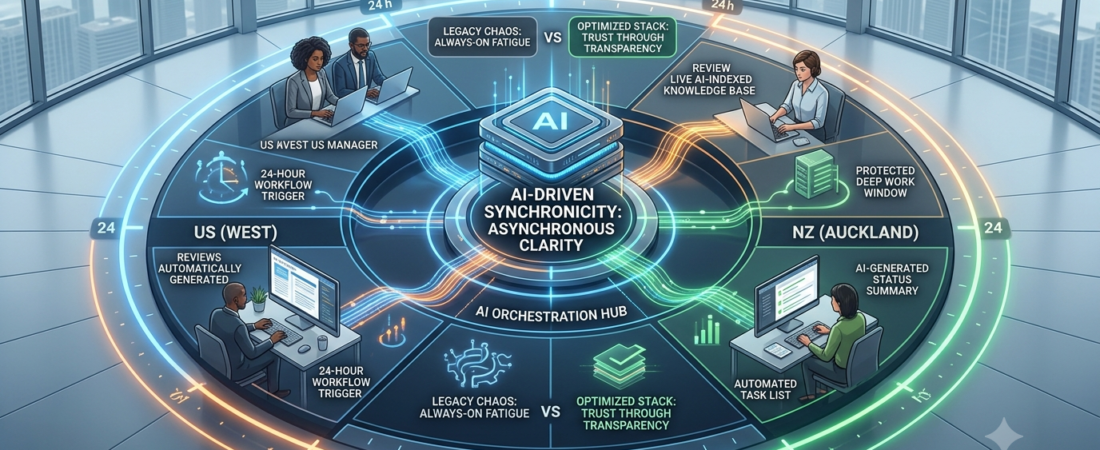
Time-zone gaps are often a competitive advantage if managed correctly. You can effectively operate a “24-hour delivery cycle.”
- Handoff Protocols: Build an AI-driven “Handoff Agent.” At the end of the US business day, the agent automatically aggregates all open tasks, flags blockers, and generates a structured summary for the incoming AU/NZ team.
- The Result: The AU/NZ team starts their day with a clear, prioritized list, while the US team has a “completed” report waiting for them the next morning.
3. Protecting “Deep Work” Windows
To scale an agency, your team needs 4-hour blocks of uninterrupted work.
- Smart Scheduling: Use AI-driven calendars (like Reclaim.ai or Motion) that automatically protect “Deep Work” time and only allow meetings when they are truly necessary for consensus, not just status updates.
- The Policy: “If it can be handled in a project management ticket or an asynchronous video note (like Loom), it should never be a meeting.”
Implementation Table: The Asynchronous Operating Model
| Challenge | Old Way (Synchronous) | New Way (Async AI) |
| Status Updates | Weekly Sync Calls | AI-Generated Daily Digests |
| Task Handoffs | Email Chains/Slack Pings | Automated Workflow Triggers |
| Knowledge Sharing | Team Meetings | Live AI-Indexed Knowledge Base |
| Blocked Work | Waiting for manager login | Agent-led escalation & logging |
Conclusion: Trust Through Transparency
Managing across time zones is not about surveillance; it is about infrastructure. When you provide your team with clear protocols, high-context documentation, and AI-driven workflows, you remove the need for “checking in” and replace it with “delivering results.”
This approach builds high-trust, high-performance cultures—the hallmark of the most successful 2026 digital agencies.